Short answer: the only RAD-140 doses ever tested in people were 50, 100 and 150 mg a day, in 22 women with advanced breast cancer, where 100 mg was the maximum tolerated dose and liver-enzyme rises were the most common side effect (LoRusso 2022). No trial has tested RAD-140 for muscle. Users commonly report 5–20 mg a day for 6–8 weeks; those doses are anecdotal, and their effect on testosterone in men has never been measured.
This guide sets out the trial data, what users report for different goals, half-life and timing, women, and what to check before and after. Full compound profile: RAD-140 fact sheet.
What Makes RAD 140 a Game-Changer?
RAD-140 (testolone, now named vosilasarm) is a nonsteroidal SARM first described in 2011. In rats it grew a hormone-sensitive muscle at very low doses with less effect on the prostate, and in young male monkeys 28 days raised body weight by more than 10% (Miller 2011). Those animal results are why it is popular. The human picture is different: its only published trial was in cancer patients, it is now being tested again for breast cancer as EP0062 (NCT05573126), and it is not approved anywhere we could find.
The old version of this page said RAD-140 works “without causing liver toxicity or severe hormone imbalances”. The evidence says otherwise: AST rose in 59% and ALT in 45% of trial patients, serious rises in 23% (LoRusso 2022); several case reports describe cholestatic liver injury in users (Perananthan 2024); and in monkeys it cut testosterone from about 600–800 to 200–300 ng/dL (Miller 2011). It is often compared with LGD-4033, which does have muscle data in people.
RAD 140 Dosage Guide for Jaw-Dropping Results

| Source | Dose | Who and how long | What happened |
|---|---|---|---|
| Phase 1 trial (LoRusso 2022) | 50, 100 or 150 mg/day | 22 postmenopausal women with ER+/HER2- metastatic breast cancer, until progression | Maximum tolerated dose 100 mg; AST up 59%, ALT 45%, bilirubin 27%; vomiting, dehydration and appetite loss 27% each; 1 partial response |
| User reports: bulking | 10–20 mg/day, 8 weeks | Self-reported | Not measured |
| User reports: cutting | 5–10 mg/day, 8 weeks | Self-reported | Not measured |
| Dose studied | Who took part | Duration | What the study found | Source |
|---|---|---|---|---|
| 50, 100 or 150 mg/day | Postmenopausal women with heavily pretreated ER+/HER2- metastatic breast cancer (n=22) | Daily until disease progression (median progression-free survival 2.3 months) | Open-label Phase 1 dose-escalation (3+3) with a pharmacokinetic expansion The maximum tolerated dose was 100 mg/day. AST rose in 59% and ALT in 45% of patients; serious (grade 3/4) AST/ALT rises occurred in 23%. One patient had a partial response. SHBG fell in all 18 patients measured. | PubMed 2022 |
Sources: the studies linked in the table.
Evidence level: anecdotal. RAD-140 has never been tested for muscle, strength or fat loss in people, so these ranges are what users commonly report, not tested or recommended doses.
- Muscle growth: users most often report 10–20 mg a day. The old version said 15–30 mg “without excessive side effects”; there is no evidence for that.
- Fat loss / cutting: users report 5–10 mg a day on a calorie deficit. RAD-140 has never been shown to increase fat loss in people.
- Strength / performance: users report 5–15 mg a day. No study has measured strength.
For real-world reports, see RAD-140 before and after; for combinations, RAD-140 stacks.
Factors Influencing the Right Dosage

Because there is no tested dose for muscle, the factors below are about risk, not about finding a “right” number:
- Liver: liver-enzyme rises were the most common side effect in the trial, and case reports describe cholestatic injury after weeks to months of use; anyone with liver problems or who drinks heavily is at more risk. See are SARMs liver toxic.
- Hormones: testosterone suppression was strong in monkeys; age and baseline testosterone affect how much that matters.
- Heart: case reports describe myocarditis in young men, including a 16-year-old after his first dose (myopericarditis case 2024); cause and effect are not proven.
- Product strength: only 41% of 44 tested SARM products matched their label (Van Wagoner 2017), so the number on the bottle may not be the dose you take.
RAD 140 Dosage Per Day for Consistent Output
RAD-140’s half-life is about 45 hours (44.7 h in the trial), which supported once-daily dosing (LoRusso 2022). The old version of this page gave 16–20 hours; the trial figure is more than twice that. Practical consequences:
- One dose a day is enough; splitting has no basis.
- Levels build up over the first week of daily dosing, so effects (and side effects) accumulate.
- Time of day matters little; see RAD-140 morning or night.
- Liquids: the dose depends on the concentration on the label. At 10 mg/ml, 1 ml is 10 mg and 0.5 ml is 5 mg; see how to take liquid SARMs.
- A long half-life does not reduce suppression or liver risk, as the old version claimed; it only means levels are steady.
RAD 140 Dosage for Beginners to Start Safely
No RAD-140 dose has been shown to be safe, so there is no “safe starting dose”. Users new to it most often report 5–10 mg a day (anecdotal). What actually reduces risk is knowing your baseline: testosterone, LH, FSH, lipids and liver enzymes before you start and after you stop. The PCT and bloodwork planner lists the markers, and RAD-140 PCT covers recovery.
Tailored RAD 140 Female Dosage for Expected Results
The only human RAD-140 data come from women, but they were postmenopausal women with advanced breast cancer taking 50–150 mg a day, where side effects were common (LoRusso 2022). There are no data for healthy women. The 5–10 mg a day suggested online for women is a guess. RAD-140 acts on the androgen receptor, and SHBG fell in every trial patient measured, a sign of androgen activity. Its effects in healthy women have not been studied. See SARMs for women.
Choosing a RAD-140 product
The old version of this page ranked five sellers. We have replaced that list: we can’t verify the purity or user claims that were made about the other brands, and Sarmguide does not recommend competitors of our partner shop.
Why Brand Matters: Trust and Quality Assurance
Quality is a real risk with RAD-140. In the JAMA test of products sold as SARMs, only 52% contained a SARM, 39% contained another unapproved drug and 41% matched the label (Van Wagoner 2017). What to look for:
- A third-party lab report (COA) for the exact batch, from a lab not owned by the seller.
- A clear product page with the strength per capsule or per ml.
- Clear shipping, payment and support terms.
Our current pick

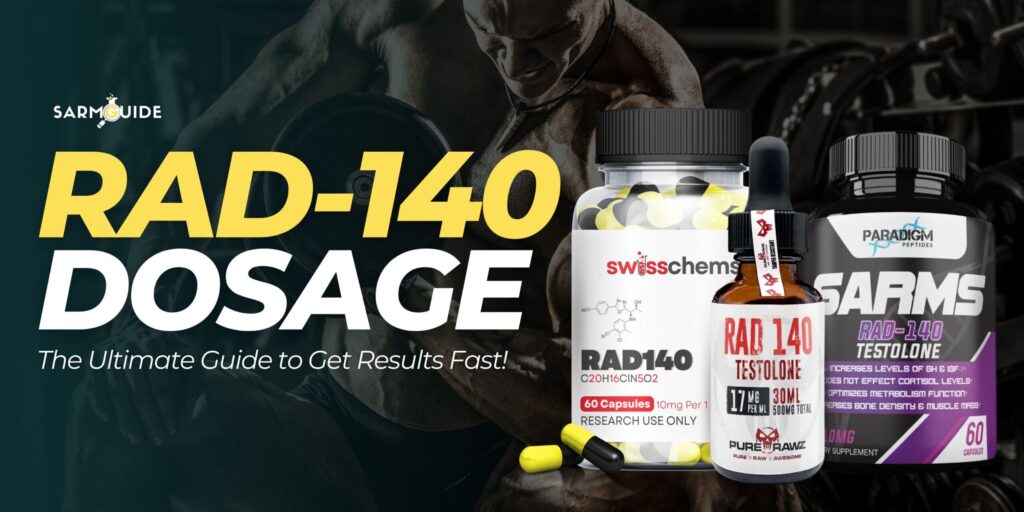
Our partner shop is SwissChems, which sells RAD-140 (testolone) as 10 mg capsules, 60 per bottle. Why we picked it, what we checked on its public pages and what we could not verify are in the SwissChems review. We earn a commission if you buy through our links; it doesn’t change what we say about RAD-140 itself.
What the right dose can and can’t do

The old version of this section promised that the “correct” dose preserves natural testosterone, builds muscle without fat and reduces soreness. None of that has been tested. What can be said:
- Testosterone: no dose has been shown to preserve it; suppression was strong in monkeys.
- Muscle: not measured in people; animal data only.
- Side effects: in the trial, liver-enzyme rises occurred across doses, and 100 mg was the most patients could tolerate.
Final Thoughts
There is no researched RAD-140 dosage for building muscle. The only human doses were 50–150 mg a day in women with advanced cancer, where liver-enzyme rises were common; the 5–20 mg a day users report has never been studied, and neither has its effect on testosterone in men. If you are weighing RAD-140, get bloodwork before and after, watch for signs of liver problems, and compare it with compounds that have human muscle data in the SARMs database.
Frequently asked questions
What is the RAD-140 dosage?
No tested dose for muscleEvidence: Trial
The only human trial used 50, 100 or 150 mg a day in women with advanced breast cancer, with liver-enzyme rises common. The 5–20 mg a day users report is anecdotal.
What is the RAD-140 dose for cutting vs bulking?
Untested for eitherEvidence: User reports
User reports put cutting at about 5–10 mg a day and bulking at 10–20 mg. No study has tested RAD-140 for either goal.
How many ml of RAD-140 per day?
Depends on the concentrationEvidence: Limited
The volume depends on the mg/ml on the label: at 10 mg/ml, 1 ml contains 10 mg and 0.5 ml contains 5 mg. No dose has been tested for muscle.
What is the half-life of RAD-140?
About 45 hoursEvidence: Trial
It was 44.7 hours in the Phase 1 trial, which supported once-daily dosing. The 16–20 hours quoted on some sites is not what the trial found.
Can women take RAD-140?
No data in healthy womenEvidence: Trial
The only trial was in postmenopausal women with advanced breast cancer at 50–150 mg a day, where side effects were common. Online suggestions of 5–10 mg for women are guesses.
What happens if you miss a dose of RAD-140?
Levels fall slowlyEvidence: Trial
With a half-life of about 45 hours, levels fall only slowly after one missed dose. Doubling up is not advised; there are no data on it.
How long should a RAD-140 cycle be?
Never testedEvidence: User reports
No study has tested any length of use in healthy people; 6–8 weeks is what users report. Liver injury case reports appeared after weeks to months of use.
Sources
- A First-in-Human Phase 1 Study of a Novel Selective Androgen Receptor Modulator (SARM), RAD140, in ER+/HER2- Metastatic Breast Cancer
- Design, Synthesis, and Preclinical Characterization of the Selective Androgen Receptor Modulator (SARM) RAD140
- ClinicalTrials.gov NCT05573126: Phase 1/2 Study to Evaluate EP0062 as Monotherapy and in Combination in Patients With Advanced or Metastatic AR+/HER2-/ER+ Breast Cancer
- Severe liver injury following use of RAD-140, a selective androgen receptor modulator, for body building
- Myopericarditis Following Use of Selective Androgen Receptor Modifier "RAD-140"
- Chemical Composition and Labeling of Substances Marketed as Selective Androgen Receptor Modulators and Sold via the Internet
- Human In Vivo Metabolism and Elimination Behavior of Micro-Dosed Selective Androgen Receptor Modulator RAD140 for Doping Control Purposes