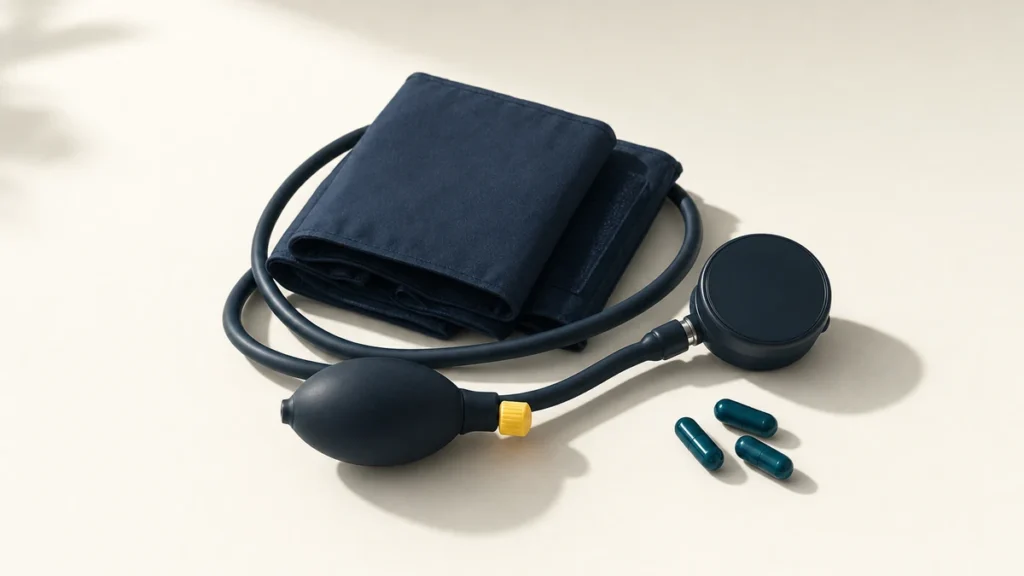

Short answer: SARMs have not been shown to raise blood pressure directly, but they have not been shown to be safe for it either. None of the SARM trial results we checked reports a rise in blood pressure, and none measured it as a main outcome. What the trials do show is a drop in HDL (“good”) cholesterol, by 17–27% on ostarine at 1–3 mg/day, which matters for heart health over time. The FDA warns that SARMs may increase the risk of heart attack and stroke, and RAD-140 has case reports of heart failure and heart-muscle inflammation.
The one compound in this group with a measured blood pressure rise is MK-677, which is not a SARM: in frail older adults after hip fracture, systolic pressure rose about 12–16 mmHg above baseline. Below: what is known for each compound, why the numbers you see online are mostly guesses, and how to check your own blood pressure.
Why blood pressure matters

Blood pressure measures the force of blood pushing against artery walls as the heart pumps. Chronically elevated blood pressure increases the risk of heart disease, stroke, kidney damage, and other long-term health complications.
Blood pressure is influenced by many factors, including body weight, fluid balance, vascular tone, kidney function, stress levels, and hormonal signaling. Because SARMs interact with androgen receptors and can influence body composition and metabolism, it’s reasonable to ask whether they may indirectly or directly affect blood pressure regulation.
HDL cholesterol and SARMs
The best-documented heart-related effect of SARMs is on blood fats. In the 86-day ostarine trial in older adults, HDL fell 17% on 1 mg/day and 27% on 3 mg/day, while total cholesterol and triglycerides also fell and LDL did not change. In the 21-day LGD-4033 trial in young men, HDL and triglycerides fell with dose and returned to baseline after stopping. In a case report of a man taking LGD-4033 with MK-677 for 5 weeks, HDL fell 36% and LDL rose 40%.
Low HDL does not raise blood pressure by itself. But low HDL and high LDL are risk factors for heart disease, which is why a lipid panel is one of the tests the trials tracked. See our bloodwork guide.
Blood pressure by compound
You will see a millimeter-of-mercury figure for each SARM online (for example “5 to 10 mmHg” for ostarine or “up to 40 mmHg” for S-23). None of those numbers comes from a study. This is what is actually known.
1. Ostarine
Ostarine has the most human data of any SARM, with trials in older adults, cancer patients and people on Wegovy. None of the trial results we checked reports a blood pressure rise as a side effect. The documented effects are lower HDL (17–27%), lower total testosterone and, in a Phase 1 study, dose-dependent rises in the liver enzyme ALT. If you have high blood pressure already, “no reported rise” in short trials is not the same as proven safe. More in the ostarine fact sheet.
2. Ligandrol (LGD-4033)
The two LGD-4033 trials (3 and 12 weeks) did not report blood pressure problems in their published results. HDL fell with dose in the 21-day trial. In a case report of LGD-4033 plus MK-677, HDL fell 36% and LDL rose 40% in 5 weeks, and LDL stayed higher after stopping. See the LGD-4033 fact sheet.
3. RAD-140
RAD-140 has never been tested for blood pressure in people; its only trial was in women with advanced breast cancer, and it focused on liver and other side effects. Case reports describe myopericarditis (heart-muscle and lining inflammation) in a young man and in a 16-year-old boy, and heart failure in a man who used it; cause and effect is not proven. That is reason enough for anyone with heart or blood pressure problems to be cautious. See the RAD-140 fact sheet.
4. Andarine (S4)
There are no published human trial results for andarine, so there is no blood pressure data. See the S4 fact sheet for what is known.
5. YK-11
YK-11 has only been studied in cells. It has a steroid structure (it is derived from DHT) and acts on the androgen receptor, so effects on lipids similar to other androgens would be expected, but nothing has been measured in people. See the YK-11 fact sheet.
6. S-23
S-23 has only been studied in animals. In male rats it suppressed LH by more than half at low doses and, combined with estradiol, stopped sperm production in most animals, which is why it was studied as a male contraceptive; fertility returned after treatment stopped. Blood pressure was not studied. See the S-23 fact sheet.
7. MK-677 (not a SARM)
MK-677 is the only compound here with a measured blood pressure rise. In a hip-fracture trial in older adults at 25 mg/day, systolic blood pressure rose about 12–16 mmHg above baseline, with little change on placebo, and congestive heart failure occurred in 4 of 62 patients vs 1 of 61 on placebo; the trial was stopped early. Water retention (leg swelling) was common in other trials too. The FDA cites this heart-failure signal as a significant safety risk. See MK-677 side effects.
8. Cardarine (not a SARM)
In its human trials, cardarine improved blood fats (HDL up to 16.9% higher, triglycerides and LDL lower) and it is sometimes suggested to “stabilize” blood pressure. We don’t recommend that: blood pressure was not an outcome in those trials, and its development was stopped after cancers in long-term animal studies. See the cardarine fact sheet.
Indirect ways SARMs may affect blood pressure
While SARMs may not directly raise blood pressure through the same mechanisms as traditional anabolic steroids, indirect effects are possible. These include:
1. Water Retention and Fluid Balance
Users report water retention with some compounds, and it is well documented for MK-677. Increased extracellular fluid can temporarily raise blood pressure in susceptible individuals, especially those already prone to hypertension.
2. Changes in Lipid Profiles
Trials found HDL drops of 17–27% with ostarine. While this does not immediately raise blood pressure, unfavorable lipid changes can contribute to long-term cardiovascular strain if unmanaged.
3. Increased Body Mass
Lean mass gains can be beneficial, but rapid changes in body weight (especially when combined with increased caloric intake) may affect blood pressure regulation in some individuals.
4. Stress and Training Intensity
Many people using SARMs increase training volume and intensity. Overreaching, insufficient recovery, poor sleep, and elevated sympathetic nervous system activity can all contribute to temporary blood pressure elevation, regardless of supplementation.
SARMs vs Anabolic Steroids and Blood Pressure

To understand the concern fully, it helps to compare SARMs to traditional anabolic steroids.
Anabolic steroids are well documented to increase blood pressure through multiple pathways, including sodium and water retention, adverse lipid changes, increased hematocrit, and direct vascular effects. Hypertension is a recognized risk of steroid use.
SARMs do not convert to estrogen, so some of these routes may matter less. But no study has compared SARMs and steroids on blood pressure, so “lower risk than steroids” is an assumption, not a finding. See SARMs vs steroids.
However, “lower risk” does not mean “no risk,” especially for individuals with pre-existing cardiovascular conditions.
Individual Factors That Matter
Whether SARMs cause blood pressure increase can depend heavily on the individual. Key variables include:
- Baseline blood pressure and cardiovascular health
- Genetics related to fluid retention and vascular response
- Diet quality, sodium intake, and hydration
- Sleep quality and stress levels
- Training load and recovery habits
Someone with normal blood pressure, good lifestyle habits, and regular monitoring may see no meaningful changes. Someone with borderline hypertension or poor recovery habits may notice elevations even without SARMs involved.
Warning signs that need medical care
High blood pressure usually has no symptoms, which is why it has to be measured. But these symptoms can mean a dangerous rise or a heart problem, and need medical care straight away:
- severe headache
- chest pain
- difficulty breathing
- dizziness or fainting
- blurred vision
- an abnormal or racing heartbeat
- nosebleeds with a pounding headache
Tell the doctor exactly what you have taken. Heart-related case reports with SARMs often involved several compounds at once.
How to check and lower your blood pressure
Blood pressure is cheap and easy to measure: a validated upper-arm home monitor, readings taken seated after a few minutes of rest, on several days. The American Heart Association’s reading categories (normal, elevated, stage 1 and stage 2) tell you what the numbers mean. Measure before starting anything that might affect it, so you have a baseline.
Diet and lifestyle
The usual measures apply: a diet rich in fruit and vegetables, less sodium, less alcohol, no smoking, enough sleep and regular exercise.
If your readings are high, the step that works is stopping the compound and seeing a doctor, not adding another drug.
What research can and can’t tell us
Most SARM studies are relatively short-term and involve controlled environments. Long-term cardiovascular outcomes, including chronic blood pressure changes, are not fully understood.
Additionally, research compounds differ in structure, potency, and selectivity. Results observed with one SARM do not automatically apply to all others. This uncertainty is why broad generalizations should be avoided.
Conclusion
There is no trial evidence that SARMs directly raise blood pressure, and no trial was designed to find out. The documented heart-related effect is lower HDL cholesterol; RAD-140 has heart case reports; and MK-677, not a SARM, did raise blood pressure in frail older adults. Measure your blood pressure and lipids, take symptoms seriously, and treat online mmHg figures as guesses. Related: SARMs side effects · do SARMs lower testosterone? · SARMs database
Frequently asked questions
Do SARMs raise blood pressure?
Not shown; not ruled outEvidence: Limited
No SARM trial has shown a rise, but none measured blood pressure as a main outcome. The documented heart-related effect is lower HDL cholesterol, and the FDA warns SARMs may increase the risk of heart attack and stroke.
Does RAD-140 raise blood pressure?
Never testedEvidence: Limited
It has never been tested for blood pressure in people. Case reports describe heart-muscle inflammation and heart failure in men who used RAD-140, though cause and effect is not proven.
Does ostarine raise blood pressure?
No rise reported in trialsEvidence: Trial
None of the ostarine trial results checked reports a blood pressure rise. Ostarine did lower HDL cholesterol by 17–27% at 1–3 mg/day over 86 days.
Does MK-677 raise blood pressure?
Yes, in one trialEvidence: Trial
In frail older adults after hip fracture, 25 mg/day raised systolic blood pressure about 12–16 mmHg above baseline, and the trial was stopped early over heart failure.
Do SARMs raise cholesterol?
They lower HDLEvidence: Trial
They lower HDL ("good") cholesterol: by 17–27% on ostarine and in a dose-dependent way on LGD-4033. In a case report of LGD-4033 plus MK-677, LDL rose 40% and HDL fell 36%.
Are SARMs hard on your heart?
They may beEvidence: Human data
They lower HDL, the FDA warns they may increase the risk of heart attack and stroke, and RAD-140 has heart failure and myocarditis case reports. Long-term heart data do not exist.
Are SARMs safer for blood pressure than steroids?
Never testedEvidence: Limited
SARMs do not convert to estrogen, which may matter, but no study has compared SARMs and steroids on blood pressure.
Should blood pressure be monitored when using SARMs?
YesEvidence: Limited
It is cheap and easy with a home monitor. High readings or symptoms such as chest pain or severe headache are a reason to stop and see a doctor.
Sources
- The selective androgen receptor modulator GTx-024 (enobosarm) improves lean body mass and physical function in healthy elderly men and postmenopausal women: results of a double-blind, placebo-controlled phase II trial
- The safety, pharmacokinetics, and effects of LGD-4033, a novel nonsteroidal oral, selective androgen receptor modulator, in healthy young men
- LGD-4033 and MK-677 use impacts body composition, circulating biomarkers, and skeletal muscle androgenic hormone and receptor content: A case report
- Selective androgen receptor modulator abuse-induced heart failure: catastrophic effects of RAD-140 (Testolone)
- Myopericarditis Following Use of Selective Androgen Receptor Modifier "RAD-140"
- FDA Briefing Document, Pharmacy Compounding Advisory Committee, 29 October 2024: Ibutamoren Mesylate
- Lipid effects of peroxisome proliferator-activated receptor-δ agonist GW501516 in subjects with low high-density lipoprotein cholesterol: characteristics of metabolic syndrome
- FDA: Certain bodybuilding products put consumers at risk for heart attack, stroke, serious liver damage and more (content current as of 2 December 2025)
- Preclinical characterization of a (S)-N-(4-cyano-3-trifluoromethyl-phenyl)-3-(3-fluoro, 4-chlorophenoxy)-2-hydroxy-2-methyl-propanamide: a selective androgen receptor modulator for hormonal male contraception
- Selective androgen receptor modulator, YK11, regulates myogenic differentiation of C2C12 myoblasts by follistatin expression
- Understanding Blood Pressure Readings (American Heart Association)